Goals vs Structure: Why Structure Creates Real Results
Oct 20, 2026Most people have goals. They write them down. They talk about them. They visualize the outcome. And sometimes they become highly motivated by what they see. But months later, the goal is still sitting there. Not necessarily because they lacked ambition. Not necessarily because they lacked ability. And not always because they lacked discipline. Often, something more fundamental was missing: They had a destination—but never built enough structure to consistently move toward their goal. Goals matter. But goals alone don't create consistent execution.
Structure helps you turn your direction into organized action.
The Problem Isn't Goals
Let's make an important distinction. Your goals are useful and necessary. A good goal identifies a desired outcome.
It answers the question: Where am I trying to go?
That's essential. Without clarity and direction, adding structure can make you more efficient at going somewhere you never intended to go. The problem isn't having goals. The problem is expecting the goal to do a job it was never designed to do. A goal can tell you to lose 30 pounds, build a $250,000 business, write a book, leave corporate employment, become debt-free, or develop a team. Those outcomes provide direction. But they don't automatically tell you what must happen on Monday morning.
That's where structure comes in, and structure is extremely important.
Here's What Your Goals Actually Do
Your goals help you establish and clarify direction, intention, desired outcomes, priorities, and measurements of success.
They help answer the question: What am I trying to accomplish and why?
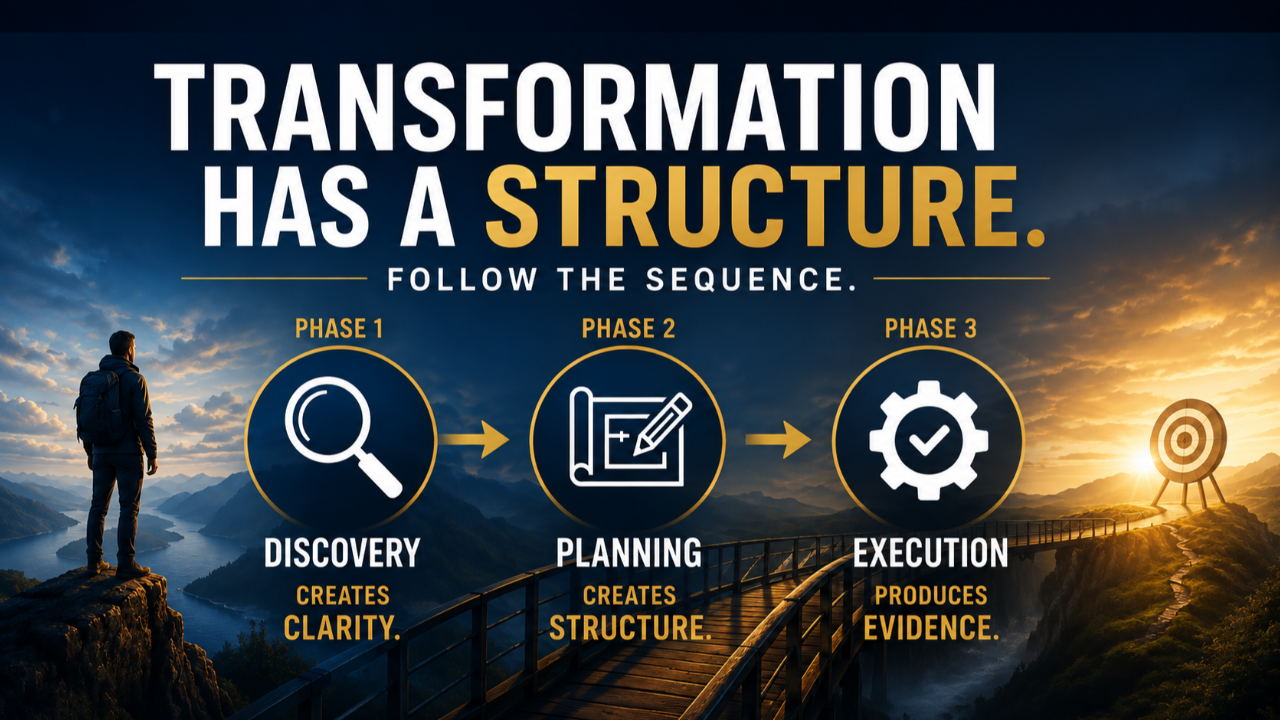
That's valuable. But knowing what you want is only part of the transformation. As we explained in The 3 Phases of Real-Life Transformation, clarity must eventually become planning, and planning must eventually become execution.
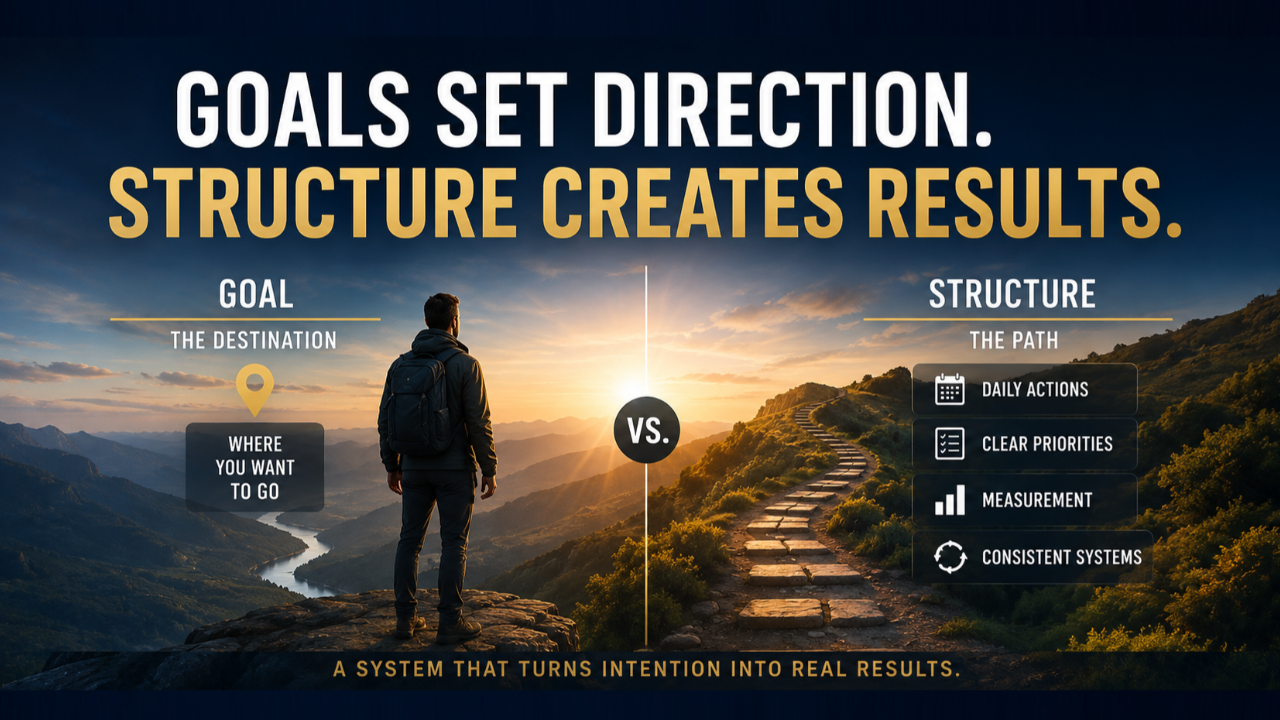
This gives us an important distinction: Your goals establish the destination. They don't automatically create the structure required to achieve it.
Structure requires a little bit more.
Here's What Structure Actually Does
Structure organizes your decisions, actions, standards, resources, and routines to support your movement toward the goal. It helps you determine and decide what happens first, what happens next, what gets done daily, what gets done weekly, what standards govern your performance, what gets measured, what gets repeated, and lastly, what happens when your progress falls behind.
This is why we define structure more broadly than a schedule or checklist: Structure is the organization of your thinking, decisions, and actions in a way that supports your consistent performance over time. Your calendar is a part of your structure. Your system, the one you choose to apply, becomes a part of your structure. And your daily, monthly, and weekly routine are all a part of your structure.
However, none of those alone is the entire structure. Your structure is the blueprint, plan, specification, and operating procedure organizing and aligning those elements toward the desired outcome.
Here's The Core Difference
The simplest distinction is:
- Your goal defines where you want to go.
- Your plan maps the route from where you are to where you want to be.
- Your structure organizes the values, conditions, resources, standards, and systems that support your movement from Point A to Point B.
- Your execution is the PCACIAs you take as you walk the route.
- Your evidence is what reality reveals along the way.
Goals give direction. Plans provide the route. Structure supports the journey. Execution creates movement. And evidence tells us what's actually happening. This matters because many travelers spend enormous amounts of time and energy defining destinations without building the conditions necessary to reach them. They know what they want. They just haven't sufficiently organized how they'll operate to get what they desire.
Here's Why Goals Fail Without Structure
Imagine someone establishes a goal. They say:
“I want to grow my business.”
That's direction.
But Monday arrives... What happens?
Who will they contact? How many conversations will they initiate? How will their prospects enter the pipeline? When will the follow-up happen? What activity gets measured? How often will their performance be reviewed? And what happens if their strategy isn't producing results?
If those questions remain unanswered, the individual must repeatedly decide what to do. And that creates friction.
Eventually, their behavior starts depending on: Their Motivation, Their Mood, Their Energy, Their Urgency, Their Memory, and Their Circumstances
That's why their consistency begins to break down.
What Looks Like a Discipline Problem Is Actually a Structural Problem
This distinction matters. Because when people fail to consistently execute and follow-through, they often conclude or say things like: “I need more discipline.”
Sometimes they do. But often they're expecting discipline to compensate for poor design. So, for them, every day is another decision. Every week becomes another reset. Their priorities remain unclear and misaligned. Their progress isn't measured. Their standards change with their mood and motivation. It's up and it's down. Eventually, operating this way, even a disciplined person wastes time and energy repeatedly deciding things they should have already known.
This is closely related to the distinction we made in Motivation vs Structure: Why Motivation Isn't Enough to Succeed. Motivation can help you initiate action. And discipline can help you sustain that action. But structure organizes the action. Those are not the same thing.
Here's Why Structure Improves Your Execution
Good structure reduces unnecessary uncertainty. Instead of asking every morning:
“What should I work on today?”
With structure, your most important decisions have already been made. Your priorities are visible. Your standards are established. Your schedule supports your priorities, your standards, and decisions. With structure, you have established a measurable criteria. For this reason, your execution becomes easier to evaluate and sustain.
Structure creates: Greater consistency, Better focus, Clearer standards, More stable execution, Measurable progress, Faster feedback, and More deliberate actions and improvement.
This doesn't make success inevitable. It makes your execution less dependent on improvisation. And that makes your performance easier to measure and sustain over time.
Example: Goal vs Structure in Practice
Consider the goal:
“I want to grow my business.”
It's useful—but incomplete... Now begin adding structure.
The Goal: Increase qualified revenue.
The Weekly Structure:
- Initiate a predetermined number of qualified conversations,
- Conduct scheduled prospect follow-ups,
- Review the sales pipeline every Friday,
- Measure conversion activity,
- Identify bottlenecks, and
- Adjust the process based on evidence.
Now we have something to work with. The goal tells us where we're going and what we want. The structure guides how we operate as we get there. And now, our execution produces the evidence needed to determine whether the structure is working or needs adjustment.
That brings us back to the powerhouse framework:
Discovery creates clarity.
Planning creates structure.
Execution produces evidence.
The Structure Must Support the Goal, Not Replace It
There is an important warning here. Structure for its own sake isn't the objective. You can build routines, calendars, dashboards, meetings, checklists, and systems around activities that don't matter.
That's organized busyness.
The goal matters because it gives the structure direction. This is why effective planners begin with the intended outcome and work backward. Our 5-Level Powerhouse Planning Process™ uses this backward-design principle to connect your desired outcomes to the increasingly specific actions required to produce them.
So the finished result isn't: Goals OR Structure.
It's: Goals that build structure and establish direction.
- Your planning designs your route.
- Your structure organizes your execution.
- Your execution produces your evidence.
And your evidence helps us improve your structure. This makes your success repeatable, structured, and effective.
Now, How Do You Know Whether Your Life Has Structure?
One way to test this is to look beyond what you want to accomplish and examine how your life actually operates.
Ask yourself the following seven questions:
- Are my priorities clear?
- Are my most important actions scheduled?
- Are my standards established and waiting for pressure to arrive?
- Have I decided what will get measured and how?
- Are the most important activities happening consistently?
- Can I identify when my execution is drifting?
- Do I have a process for adjusting fire?
If your answers are not clear, your goals don't have enough structure to support them. However, we've incorporated a more complete diagnostic and assessment in 9 Questions to Know If Your Life Has Structure (Or Not).
That assessment moves the conversation from: “What do I want?” to: “Have I organized my life in a way capable of supporting what I say I want?”
That's a much more demanding question.
Here's The Leadership Application
The same principles applyto leadership. A leader can establish an excellent objective. They can increase their numbers. Improve their customer service scores. Grow their organizational revenue. Develop their team. And improve their execution. But announcing the goal doesn't create the operating conditions necessary to achieve your goals. Leaders must eventually translate their desired outcomes into: Priorities → Responsibilities → Standards → Processes → Actions → and Measures.
Otherwise, the organization will hear the goal but remain unclear about how to achieve it through execution. That's why strong leadership requires more than just a vision. It requires the ability to motivate, organize, and focus people, resources, time, energy, decisions, and actions toward the vision.
Here's Why Structure Without Implementation Produces Nothing
I must make one final distinction. Structure is not execution. You can build the perfect plan. You can create a well-organized calendar. Develop an awesome checklist. Install a flawless system. Establish standards. And still fail to act... Eventually, you must take the P.C.A.C.I.As, execute, and follow-through. That's why our framework doesn't end with Planning. It moves to Execution. And it's also why the distinction between learning and implementation matters.
Knowing the framework isn't the same as operating it.
The purpose of structure is not to admire the system. The purpose of structure is to support the effective execution of the operation.
Here's What Actually Works
If you want to turn a goal into measurable progress:
- Define the Goal. Know the destination. What are you actually trying to accomplish? Design the Plan. Determine the route.
- Determine what must happen first, second, and third for the desired result to become a physical reality. Build the Structure. Organize your priorities, standards, resources, systems, and recurring actions around the plan.
- Determine how you'll operate consistently, take the P.C.A.C.I.As, and follow-through? Execute and do what the structure requires.
- Turn your decisions into behavior. Measure the Evidence. Compare your actual results against your intended results.
- Evaluate what is reality telling you?
- Then: Learn. Adjust. Improve. Continue executing.
Here's The Reframe
Don't stop asking yourself: “What are my goals?”
That remains a very important question. However, there's a second part that needs to be added. Start asking:
“What structures have I built to support the attainment of my goals?”
Because wanting an outcome and organizing your life around producing that outcome are two very different things. A goal describes a future you envision, want, and desire. Your structure tells us what your present life is organized to produce. Your goals reveal what you want. Your structure reveals what your life is organized to produce.
Here's The Standard
Your goals matter. But goals alone are not sufficient.
- Your goals create direction.
- Planning creates the route.
- Structure organizes your movement.
- Execution produces evidence.
And evidence allows us to learn, adjust, and improve over time. Your objective is not to stop setting goals. It's to stop expecting your goals to do the work of structure without planning.
Next Step: Build A Structure Beneath Your Goals
If you know where you want to go but haven't translated that direction into an executable structure, the next step isn't necessarily another goal. It's to create a better plan. The Powerhouse Planning Workbook™ is designed to help leaders, builders, and founders work backward from their desired outcomes, to organize their priorities and actions, and create a practical structure for execution and follow-through.
Because the goal tells you where you want to go. The plan and structure help you build the way forward.