The Leadership Habit That Predicts Long-Term Success
Aug 18, 2026Talent does not predict long-term success—execution does. Here's why structured execution and follow-through is the leadership habit that drives consistent results and long-term performance: Most leaders are evaluated by outcomes. But often their outcomes are delayed. They appear long after decisions are made. Logn after efforts are exhausted. And often after a significant amount of time has elapsed.
So the real question becomes: What predicts those outcomes in advance?
The Wrong Focus
A lot of people still overvalue visible strengths. They look for talent, intelligence, charisma, insight, and strong starts. All of those can help. But none of them reliably predict long-term success.
Because none of them guarantee execution.
The Habit That Actually Predicts Success
There is one habit that consistently separates high-performing leaders from everyone else: Structured execution and follow-through. Not intensity. Not motivation. And not occasional effort. But the ability to consistently execute what has already been decided—over time.
Why This Matters
Anyone can start strong. But very few people sustain their execution long enough for their results to compound. Because success is not built in in small moments and sprints. It is built through repetition over time.
A Different Definition
At Powerhouse Motivations, we define structured execution and follow-through as: The consistent completion of meaningful actions within a defined structure—over time. It's not random effort. It's not reactive activity. It's planned, measured, repeated, and refined.
Why Most Leaders Struggle With Follow-Through
Most leaders don't struggle with follow-through because they care too little. They struggle with follow-through because they lack clear structure, defined standards, measurable actions, and rythmic execution cadence. So their execution becomes inconsistent, emotion-driven, dependent on motivation, and vulnerable to interruption.
Motivation does not sustain performance over time.
Structure does.
The Execution Gap
This is where many leaders lose momentum.
They make decisions, set goals, create plans, and define their intentions. But they fail to sustain their execution long enough to produce meaningful outcomes. The gap between their intentions and outcomes is where credibility is either built or lost.
Here's What Structured Execution & Follow-Through Looks Like
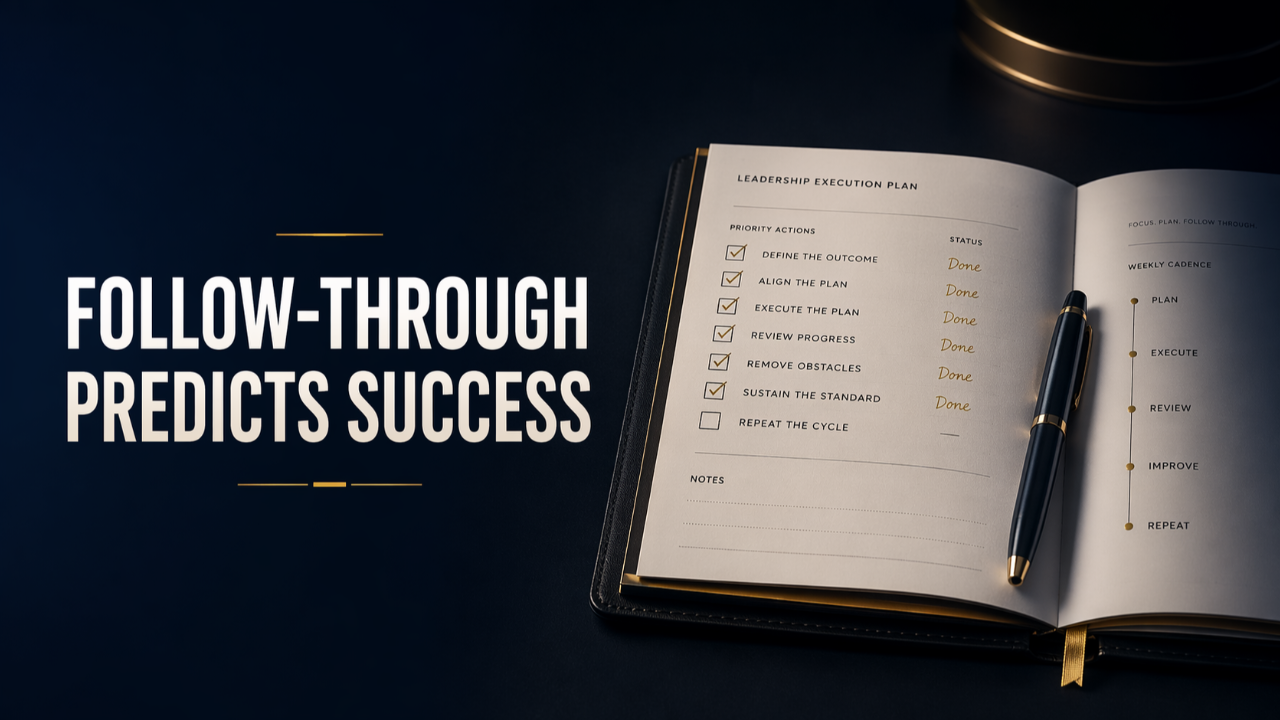
- Define clear actions. Don't rely on vague intentions. Define what actually needs to happen.
- Operate on a cadence. Daily, weekly, and monthly execution is structured. Don't reinvent the process every day.
- Track what matters. Measure your progress, not just your effort. Make your execution visible.
- Refine continuously. Adjust based on your results, not your mood. Improve based on feedback and evaluation, not emotion.
If clarity still feels unstable, revisit Why Clarity Is the Most Underrated Leadership Skill. And if your execution still depends on feeling ready, it helps to revisit the difference between motivation and structure.
The Leadership Advantage
When structured execution and follow-through is in place decisions turn into results, standards rise, confidence strengthens, and your momentum compounds. Because execution becomes more predictable.
The Reframe
If your results are inconsistent, the issue is not always effort. It's not always desire. And it's not always your potential. Very often, it's a breakdown in follow-through.
Here's The Standard
Your leadership is not defined by what you intend to do. It is defined by what you repeatedly execute, over time. Because repetition creates outcomes. And outcomes create credibility.
Here's What Actually Works
- Reduce complexity. Too many priorities destroy consistency.
- Define your non-negotiables. Define what gets done regardless of how you feel or what happens around you?
- Build a visible structure. Your calendar, workflow, and environment should reflect your priorities.
- Track your execution. What gets measured can be evaluated and improved. What stays vague usually breaks down.
This is where many leaders begin to realize that follow-through is not a personality trait. It is a structured practice.
Here's The Long-Term Effect
Over time, structured execution and follow-through creates reliability, trust, predictability, and improved performance. These are the traits that define strong leadership over time.
Strengthen Your Follow-Through
Leaders who want to strengthen their execution and build more consistent results often begin by installing structure into how they think, decide, and act. The 9-Step Life Transformation System™ is designed to help leaders create clarity, build structure, and develop consistent follow-through, so their results become repeatable, not accidental.
Explore the 9-Step Life Transformation System™
Continue Reading
To go deeper, continue with these related articles: